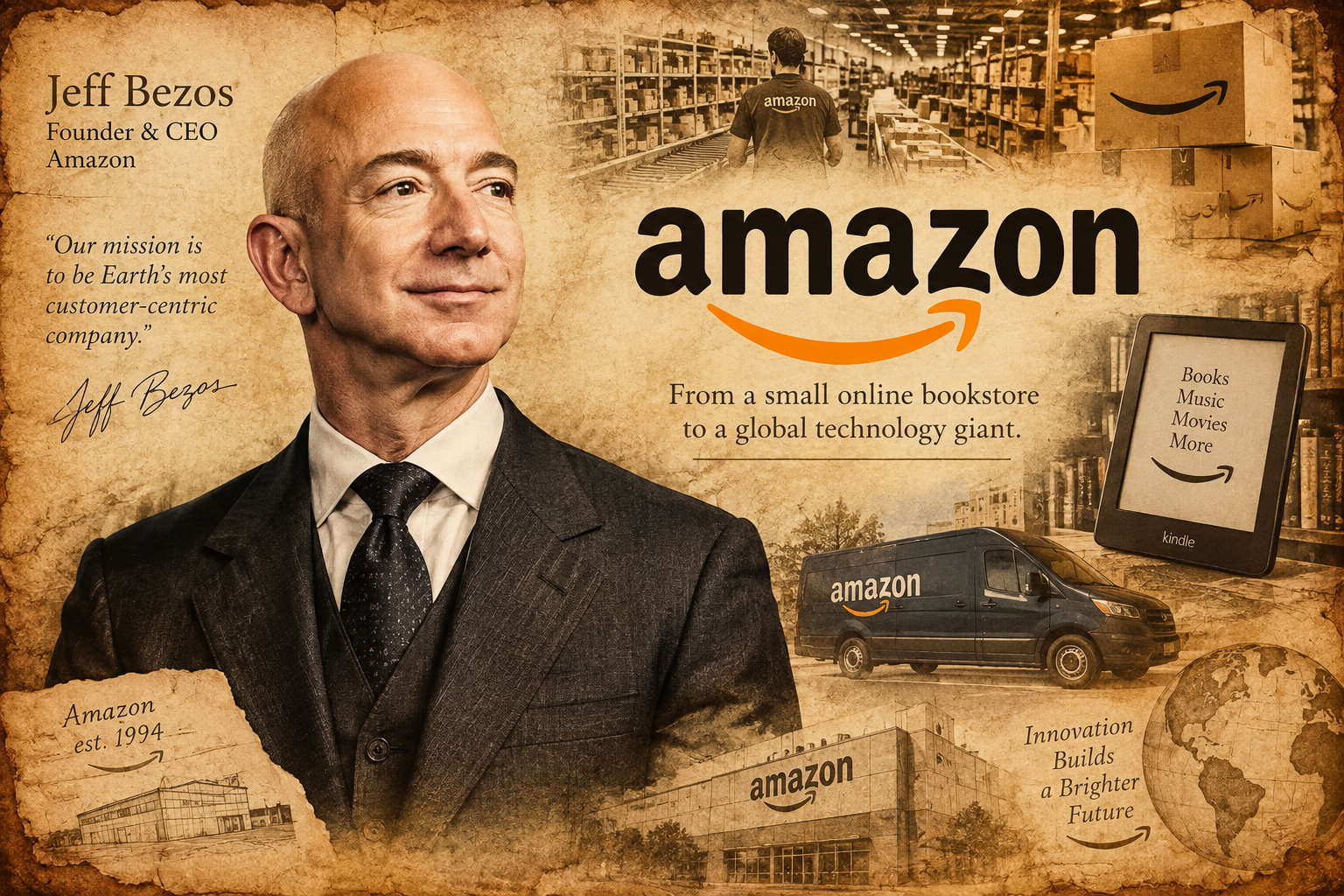
Amazon did not begin as a polished business empire. It started as a small, risky idea shaped by timing, technical curiosity, and a founder who was willing to build before the rest of the world fully understood what he was making. The company’s early years are one of the clearest examples of how a simple product decision can become the seed of a much larger transformation.
When people talk about The Origin and History of Amazon, they usually picture a giant marketplace, cloud services, and a logistics machine that reaches into daily life. But the more interesting story is how all of that grew out of a very specific moment in the 1990s, when the internet was still awkward, slow, and full of open questions. Amazon was born inside that uncertainty and learned to exploit it better than almost anyone else.
Where the idea began
Jeff Bezos was working on Wall Street before he became associated with e-commerce. While reading about the explosive growth of internet use in the early 1990s, he saw a commercial opportunity that most people had not yet taken seriously. He later described this as a “regret minimization” decision, a way of choosing the path that would be easiest to live with decades later.
The original Amazon idea was not broad retail. It was books. That choice made practical sense. Books were catalog-friendly, standardized, and available in vast quantity, which made them well suited for online ordering at a time when the web was still rough around the edges. The company could offer far more titles than a physical store without having to build a shelf for each one.
This was the core of the Amazon origin: not a grand vision of selling everything, but a focused attempt to make online shopping actually useful. It was a business built on the belief that the internet could solve a problem customers already knew well — limited selection.
The garage stage and the first months
The early company is often associated with the Jeff Bezos garage in Bellevue, Washington, where Amazon operated during its formative phase. That image has become part of business folklore, but the real significance lies in what it represents: a startup moving fast, improvising constantly, and making decisions under pressure. The setting was modest, but the ambition was not.
The first Amazon team worked with urgency. They were building a website, assembling book listings, and trying to create a system that could accept orders, process payments, and connect with suppliers. There was no guarantee that customers would trust buying books online, and no guarantee that the business would scale. Both had to be proven at once.
In 1995, Amazon launched as an online bookstore. The company began from a small base, but even the early response suggested that something was working. Customers appreciated the wide selection, the convenience, and the novelty of ordering from home. What looked like a niche concept quickly hinted at a broader shift in consumer behavior.
Why books made sense first
The choice of books was not random. Books had a huge catalog depth, which meant an online store could offer titles that no physical location could stock. That mattered in a market where local bookstores were constrained by shelf space and distribution. The internet removed those limits in a way that felt almost unfair.
There was also a cultural fit. Book buyers are often comfortable browsing, comparing, and waiting a little longer for delivery if the selection is worth it. That made books a practical first category for testing e-commerce habits. Amazon could build trust one order at a time, instead of asking people to shift their entire shopping life overnight.
This is where the company’s early identity becomes clearer. The online bookstore history is not just a footnote; it explains the logic behind Amazon’s first steps. The company learned customer service, inventory coordination, and digital catalog management in a market that was easy to understand and hard to dominate.
From Cadabra to Amazon
Before becoming Amazon, the company was briefly called Cadabra. Bezos chose the name with a magician’s flourish in mind, but the effect did not land the way he intended. The name was reportedly mistaken for “cadaver” in one conversation, which is not exactly the kind of branding momentum a new company wants.
The shift from Cadabra to Amazon was more than a cleanup of a shaky first idea. It reflected a desire for a name that sounded bigger, broader, and easier to remember. “Amazon” suggested scale, variety, and a sense of something vast and flowing. It also fit neatly near the top of alphabetical lists, which mattered more in the 1990s than people sometimes admit.
That naming choice turned out to be remarkably durable. It gave the company room to expand beyond books without sounding constrained by its original category. A name can be a cage or a launchpad. In this case, it became the second one.
What the early website was trying to do
Amazon’s first website was simple by modern standards, but it was ambitious for its time. The company needed to display large inventories, let users search and browse, and complete transactions without the kind of trust infrastructure that online shopping now takes for granted. Every step was a test of whether the web could support retail at scale.
One of Amazon’s early advantages was its obsession with convenience. It did not try to imitate a bookstore’s atmosphere. It tried to be efficient, searchable, and fast enough to make the old model feel sluggish. That difference mattered because it changed the terms of comparison. Amazon was not asking customers to choose between two stores; it was redefining what a store could be.
As the service improved, it started to create habits. Customers returned because they could find obscure titles and avoid the hassle of driving around town. That behavior, repeated thousands of times, laid the groundwork for the growth of Amazon that would follow.
The company goes public and the pressure rises
Amazon went public in 1997, only two years after launching. The offering gave the company capital, but it also brought a different kind of scrutiny. Public markets have little patience for experiments that take too long to pay off, and Amazon was still very much an experiment. Revenue was growing, but profits were not a simple story.
In the late 1990s, the internet boom encouraged investors to chase companies that promised future dominance. Amazon benefited from that wave, but the company also had to prove that it was more than a speculative web brand. The challenge was not just to attract attention. It was to convert that attention into infrastructure, customers, and repeat business.
This period shaped Amazon’s operating style. The company became comfortable living with long time horizons and short-term losses if those losses were tied to expansion. That habit would later define many of its most important decisions, from fulfillment centers to cloud computing.
Expansion beyond books
Once Amazon established itself as a reliable online book seller, the obvious question became: what else could it sell? The answer was nearly everything that could be standardized, cataloged, and shipped. Music, video, electronics, home goods, toys, and eventually groceries all entered the picture as the company widened its reach.
This expansion was not just about adding categories. It was about building a retail engine capable of handling more complexity without losing speed. The company had to manage warehouses, suppliers, pricing systems, and customer expectations across products with very different demands. That kind of scaling is messy, and Amazon embraced the mess rather than pretending it could avoid it.
The growth of Amazon came from a loop that reinforced itself: more selection brought more customers, more customers justified more infrastructure, and more infrastructure made even more selection possible. The company kept tightening that loop until it became difficult for competitors to match.
How the catalog changed the business
Amazon’s massive catalog became one of its defining strengths. In physical retail, space is scarce, and every item has to earn its spot. Online, the constraint shifts from shelf space to data management, search quality, and logistics. Amazon invested heavily in making that switch feel seamless to customers.
The result was a platform that made discovery part of the shopping experience. Customers could arrive looking for one thing and leave with three more possibilities in mind. That behavior helped Amazon evolve from a bookstore into a place where browsing itself became productive.
For shoppers, this felt different from walking into a store. The aisle was infinite, but not chaotic. That balance was hard to achieve, and it became one of Amazon’s quiet advantages.
The culture of speed and iteration
Amazon built a reputation for moving quickly, testing ideas, and abandoning what did not work. That mindset came partly from the realities of being a startup in a fast-changing market, but it also became part of the company’s identity. In practice, this meant constant adjustments to the website, fulfillment methods, and customer experience.
The company was known for working backward from customer needs, though that phrase can sound cleaner than the actual process. In reality, it meant looking at friction points and trying to remove them one by one. Faster checkout, more accurate recommendations, easier returns — these small changes added up.
I’ve seen that pattern in other businesses, too: the companies that last often win not because they invent one dramatic trick, but because they reduce friction so consistently that customers stop noticing the machinery underneath. Amazon turned that into an operating principle.
Technology becomes part of the business
One reason Amazon separated itself from many other retailers was that it treated technology as a core asset rather than a support function. The company’s engineering culture shaped everything from product search to warehouse automation. That focus made it possible to operate on a scale that would have been difficult using older retail assumptions.
As Amazon grew, its systems had to handle more traffic, more orders, and more data than a simple e-commerce startup could easily manage. Those internal pressures pushed the company toward building stronger infrastructure. Over time, that infrastructure became valuable in its own right.
This technical backbone would eventually support Amazon Web Services, but the roots were already visible in the company’s early retail operations. Amazon did not just sell online; it learned how to think like a platform company before the term was fully mainstream.
| Milestone | What it meant |
|---|---|
| 1994–1995 | Bezos develops the idea and launches Amazon as an online bookstore |
| 1997 | Company goes public and gains capital for expansion |
| Late 1990s | Categories expand beyond books, building a broader retail base |
| 2000s | Logistics, marketplace services, and cloud infrastructure become central |
The dot-com crash and the test of durability
The dot-com era rewarded optimism, then punished excess. Many internet companies disappeared when investor enthusiasm collapsed around 2000. Amazon survived, but not effortlessly. The company had to defend its model while proving that online retail could be more than hype wrapped in code.
Survival during this period mattered because it validated Amazon’s basic premise. The business was not built only on market exuberance. It had actual customers, actual demand, and a system that could withstand a much harsher environment. That distinction helped Amazon separate itself from the graveyard of failed startups.
The company’s persistence through the crash also sharpened its strategic discipline. It became more careful about execution, more aware of cash flow, and more determined to build a business that could endure. A weaker company might have folded; Amazon used the pressure to harden itself.
Marketplace, Prime, and the next phase
Amazon’s growth took on new dimensions when it opened its platform to third-party sellers. This marketplace model expanded selection without requiring Amazon to own every product itself. It also changed the economics of the site, turning Amazon into both retailer and infrastructure provider.
Later, Amazon Prime added another layer. What began as a shipping subscription evolved into a customer loyalty engine tied to convenience, entertainment, and habit. Free or fast shipping became the headline benefit, but the deeper effect was psychological. Prime made Amazon feel like a default rather than a choice.
These moves extended the company’s reach well beyond the original bookstore concept. They also revealed a broader ambition: to make Amazon not just a store, but a place where customers begin many of their shopping decisions.
Why the marketplace mattered
The marketplace changed Amazon’s scale almost overnight. Third-party sellers brought in more products, more niche offerings, and more long-tail inventory without Amazon carrying all the risk. That created a broader ecosystem and a more difficult environment for rivals to match.
For customers, the benefit was obvious: more options and faster access to unusual products. For Amazon, it meant more engagement and more opportunity to earn fees, data, and long-term loyalty. The platform became stronger precisely because it was less dependent on a single business model.
That flexibility would prove crucial as retail competition intensified. Amazon was no longer only selling goods. It was controlling the space in which many sellers competed.
Amazon Web Services and the hidden giant
One of the most consequential developments in Amazon’s history was AWS, the cloud computing division that grew out of the company’s technical needs. Amazon’s internal systems had to become more efficient and reusable, and that work led to a business that now supports a large portion of the internet.
AWS changed how people understood Amazon. The company was no longer just a retailer with an efficient website. It had become a major technology infrastructure provider, serving startups, enterprises, and public institutions. That role gave Amazon a second engine of growth outside consumer shopping.
The rise of AWS also shows how far the company had traveled from the original bookstore. The path from selling books online to operating cloud infrastructure is not obvious, but it makes sense when viewed through Amazon’s habit of turning internal problem-solving into external advantage.
Leadership, criticism, and scale
As Amazon became more influential, it also attracted more criticism. Labor conditions, competition concerns, market concentration, and the company’s pressure-cooker culture became major points of debate. These issues are part of the Amazon story too, and leaving them out would make the history feel incomplete.
Large scale creates its own gravity. A company that touches retail, logistics, media, and cloud computing inevitably affects workers, suppliers, and competitors in different ways. Amazon’s efficiency has often been praised, but its reach has also raised hard questions about power and responsibility.
Those questions matter because they show the difference between a startup story and a mature corporate history. The early romance of the garage gives way to the reality of operating on a scale that influences entire industries.
Why the Amazon story still matters
Amazon’s origin is interesting not because it was inevitable, but because it was narrow at first and expansive later. That path helps explain how digital businesses can grow from single-use tools into sprawling systems that reshape consumer expectations. The company started with books because books were manageable; it became Amazon because the internet kept opening doors.
The lessons in that story are practical. Timing matters. Product choice matters. Naming matters more than people think. And once a company earns customer trust, it can sometimes use that trust to move into areas no one would have predicted from the start.
The phrase The Origin and History of Amazon covers a lot of ground, but the core arc is surprisingly clear. A founder noticed a shift in technology, chose a category that made sense for the moment, built from a garage, and kept pushing long after the first version of the business had been outgrown. The company that emerged from that process did not stay small, and it did not stay simple. That is exactly why its beginning remains worth studying.
Key milestones at a glance
- Amazon launched in 1995 as an online bookstore.
- The company began in the well-known Jeff Bezos garage era.
- The name changed from Cadabra to Amazon before launch.
- Its catalog expanded far beyond books into general e-commerce.
- Marketplace, Prime, and AWS transformed the company into a multi-layered business.
The long shadow of a simple beginning
What stands out most in Amazon’s history is the distance between the first version of the company and what it became. The early site sold books. The later company moved packages, hosted digital infrastructure, and influenced how millions of people shop and stream and browse. The scale is astonishing, but the first step was almost plain.
That is the odd beauty of startup history. The beginning often looks too small to matter. Then years pass, habits form, and the original choice turns out to have pointed the whole enterprise in a direction no one else saw clearly enough at the time.
Amazon’s story is still unfolding, but the foundations were laid in those early decisions: the category selection, the renamed brand, the garage operation, and the steady push to make online shopping feel normal. From that point on, the company kept building, and the world kept making room for it.